


Jun 4, 2026 Daycy Gomez Graduate Fellow, Spring 2026
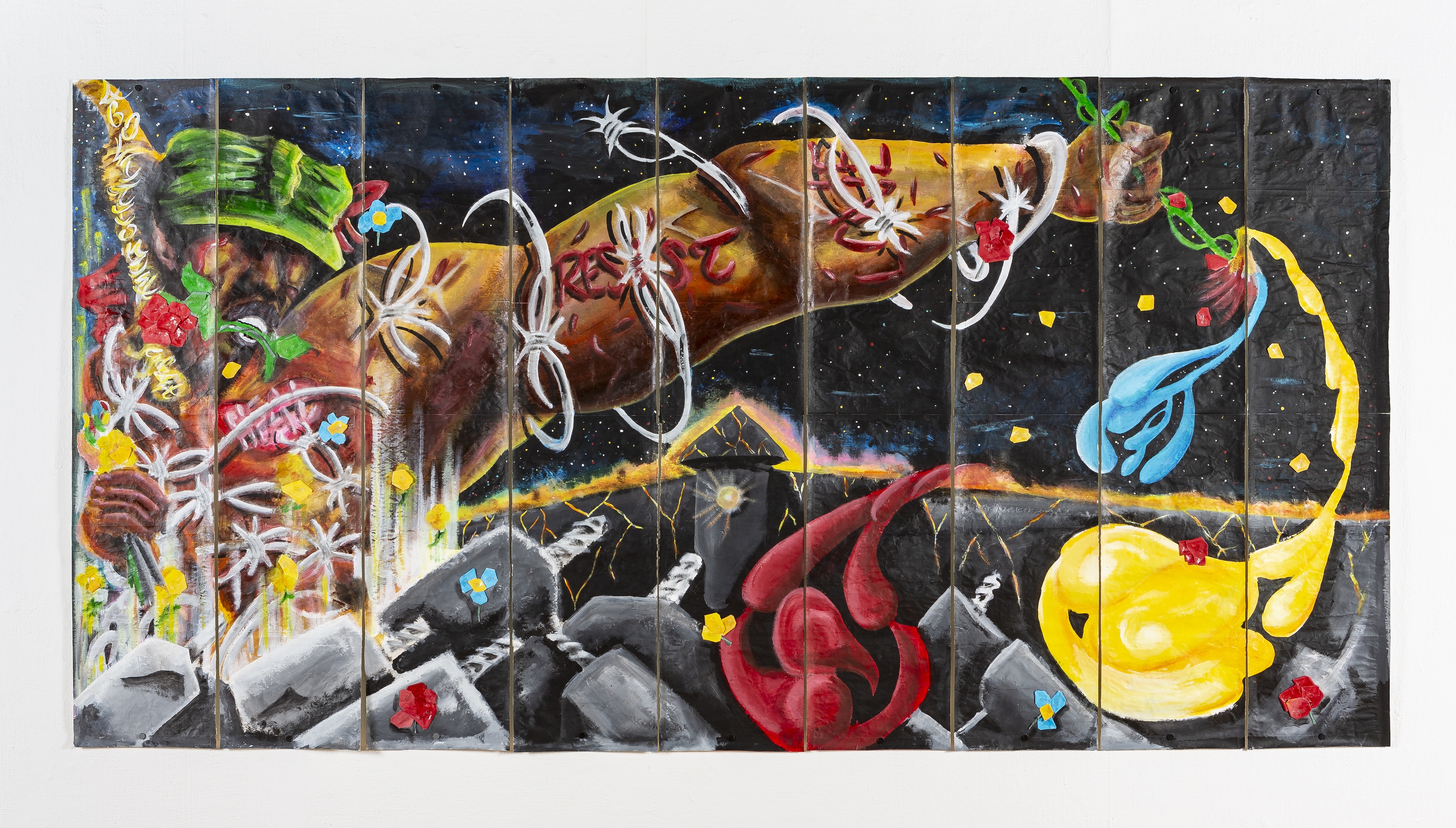
The Left Hand of Feminism, 2024, Artist Corey Devon Arthur
Daycy Gomez is a Ph.D. student in sociology. Her research focuses on police and prison abolition and liberation-focused social movements. Before becoming a graduate student, she worked for the Utah Prison Education Project which provides arts and humanities programming to incarcerated individuals at the Utah State Correctional Facility. This is where Daycy was introduced to the importance of community organizing and abolition theory.
“Police and Prison Abolition: An Ethic of Care” is a project about humanizing and relating to individuals who have gone through economic deprivation, stigmatization, and violence—essentially, criminalized folk. It looks at how abolitionist theory and practices of transformative justices pursue to replace our current violent and oppressive criminal legal system. This research connects the liberatory work of abolition to historic liberatory work done by Civil Rights educators Septima Clark, Ella Baker, Myles Horton, and others. These figures and their organizing practices of participatory democracy, empowerment, and class consciousness provide important lessons and connections to the organizing theory and work of abolition today.
There were some challenges that faced this project. Given that it was my first year as a Ph.D. student and was still in my exploratory phase of deciding what topics to research, it was difficult for me to narrow down a topic in the vast literature of abolition, liberation, and social movement. After going back and forth on some projects, a decision was finally made but not without its challenges. Overall, the research endeavor from this fellowship expanded my knowledge on abolition and liberation, which is what motivated her to become a graduate student in the first place.
To me, the interesting part about the Digital Humanities is the oxymoron in the name. The digital word is coded in 1s and 0s, and the word ‘digits’ is often used to describe our straight and rigid fingers. Pairing the digital with humanities, at first glance, seems odd. How can a seemingly inhumane place like the digital world include the humanities, in all its complexity and non-linearity? The digital world was created by humans and is sustained by us—it should include our stories, struggles, and social breakthroughs. I feel that the struggles for police and prison abolition are an important part of our human story, and need a place in the digital narrative.
I’ve gained insights on how contemporary community organizers are changing the terrain of accountability in our society. Such organizers are defying the norm of resorting to police and imprisonment systems when something bad happens. I’ve learned about how these organizers are practicing grassroots strategies today, and how organizers who came before us, such as Civil Rights leaders and organizers, left important lessons about the pursuit of liberation and abolition at a local level.
One approach to shaping your own digital scholarship project is to think about the ways we can make our community a more caring place. While riding the Utah Transit Authority-TRAX, there’s an automated message that routinely plays through the intercom that says, “Be considerate of others. Remember this is a shared space.” How can we make our shared space (social groups, neighborhoods, workplaces, cities, digital communities) better? How can our research contribute to prompting ourselves and others to be considerate of everyone in our shared space? Every research discipline plays an important part in answering this question.